Notes from the draw area
How many acres can a combine fleet cut per day?
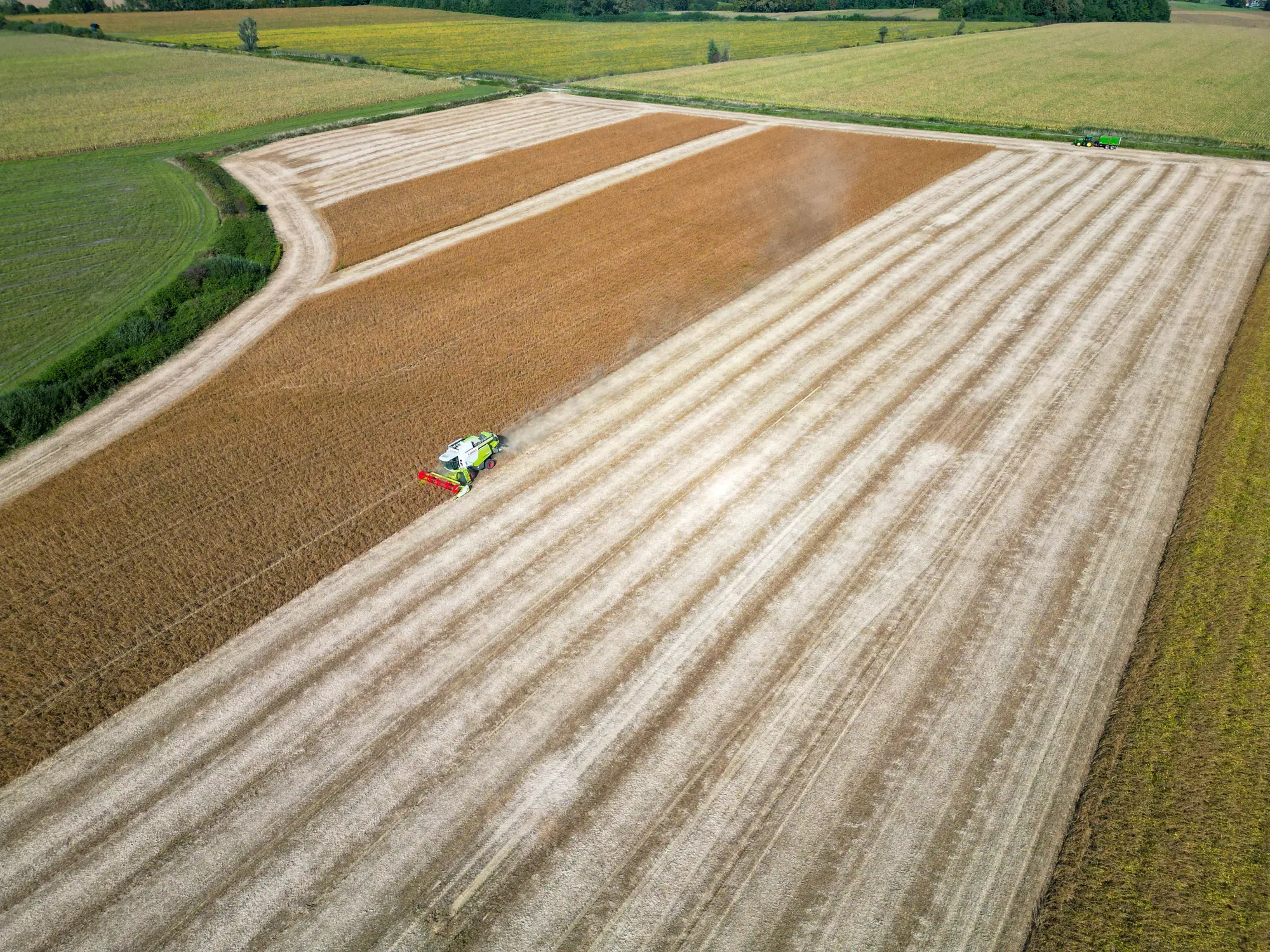
Every fall, someone in the office pulls out a notepad and tries to pin down one number before the first load hits the pit: how many acres this fleet will put through today. Truck schedules, drying bin space, and basis calls all get set off that number, and getting it wrong costs money either way, with grain backing up in the field if too few trucks are staged and drivers idling at the scale house if too many show up.
The basic combine capacity math
The starting point is a formula most ag engineering programs teach and most operators already know by feel:
Acres per hour = (Header width in feet × Ground speed in mph × Field efficiency) ÷ 8.25
The 8.25 constant converts the units so you get acres directly. Field efficiency accounts for the time a combine spends turning at the end rows, unloading on the go or stopping to unload, and general slowdowns that never show up on the spec sheet. Most operators plug in somewhere between 65% and 80% depending on field shape and how the unloading is handled.
Run the numbers on a 40-foot draper head at 5 mph and 75% efficiency: 40 × 5 × 0.75 ÷ 8.25 comes out to about 18 acres an hour. A single combine running 10 hours a day lands around 180 acres. Put five combines in the same fleet, assuming they're all running the same conditions at the same time, and you're looking at roughly 900 acres a day.
That's the ceiling. Real days rarely hit it.
Why the fleet number and the field reality diverge
The formula assumes a combine that's cutting the whole time it's scheduled to run. In practice, a fleet loses hours to things the spreadsheet doesn't know about: a header auger that needs attention mid-morning, a wet low spot that slows ground speed to a crawl, a grain cart that can't keep pace and forces the combine to wait instead of unload on the go. Lodged stalks after a wind event can cut effective speed by a third. A hot, dry afternoon might let the same fleet push past the theoretical number because moisture drops and nobody's stopping for breaks.
Then there's the bigger problem for anyone scheduling intake rather than running the combine: the acres-per-day math describes one farm's fleet on one field. Your draw area is dozens of operations, each with its own planting date, maturity group, soil type, and crew size, each deciding on its own morning whether today's the day to roll. Some fields got planted two weeks apart. Some ran a cover crop that delayed dry-down. A grower three miles north might already be two-thirds done while the fields feeding your south receiving door haven't been touched.
Add it up across a draw area and the fleet capacity formula tells you what one operation can cut in a day. It doesn't tell you how much of your draw area is cut, which is the number that drives how many trucks to stage, how much drying capacity to hold open, and when to start making basis calls before the grain shows up unannounced.
That's the gap between combine math and harvest pace math. The formula is useful for sizing a single fleet. For reading the pace of an entire draw area, you need to see where the harvested-area front sits, field by field, across every grower feeding your elevator, not just the one you called this morning.
That's the gap Harvest Progress is built to close: a weekly percent-harvested layer for your specific draw area, built from wide-swath satellite passes, so you can see how far the front has moved without working the phone tree.
If you're tired of stitching together a dozen phone calls to guess where harvest stands across your draw area, that's exactly the problem worth solving before the next truck shows up at the scale house.